

Services & Pricing
ADHD-Informed Virtual Organizing & Consulting Services
Virtual sessions available in Chicago, the continental U.S., and Canada
The Unlocking Home Program
Most organizing approaches focus on the space. Unlocking Home focuses on you.
This is a structured eight-week consulting and coaching program for ADHD and neurodivergent people who are ready to understand what executive function challenges are getting in the way and build something that lasts.
We work on the real challenges of daily home life: getting out the door in the morning, knowing what you have and where it is, managing clutter that keeps coming back, keeping up with laundry and everyday tasks, and following through consistently over time.
This is not a hands-on organizing service. It's a thinking-based process that helps you understand how your brain works and build the strategies, structure, and support to manage your home yourself.

This program draws on three distinct types of support:
Coaching: A thought-provoking and creative process designed to facilitate awareness, accountability, and progress toward your goals.
Consulting: Professional recommendations and guidance based on my training and experience as a Certified Professional Organizer®. (This often complements the work you do with an in-person home organizer).
In-Session Practice: Light practice or demonstrations, tried together when mutually agreed and relevant. This is never a full virtual organizing session.
Most sessions draw on all three, in whatever combination serves you best that day.
Unlocking Home Program Details
Investment
The total investment for the eight-week program is $1,320, paid in full before the first session.
If you choose to continue, sessions are booked in additional eight-week blocks at the same rate.
For many clients, eight weeks is just the starting point, especially when these patterns have been in place for a long time.
Program Details
Eight weeks
One session per week
90 minutes per session
Same day and time each week
Virtual via Zoom
What a Session Actually Looks Like
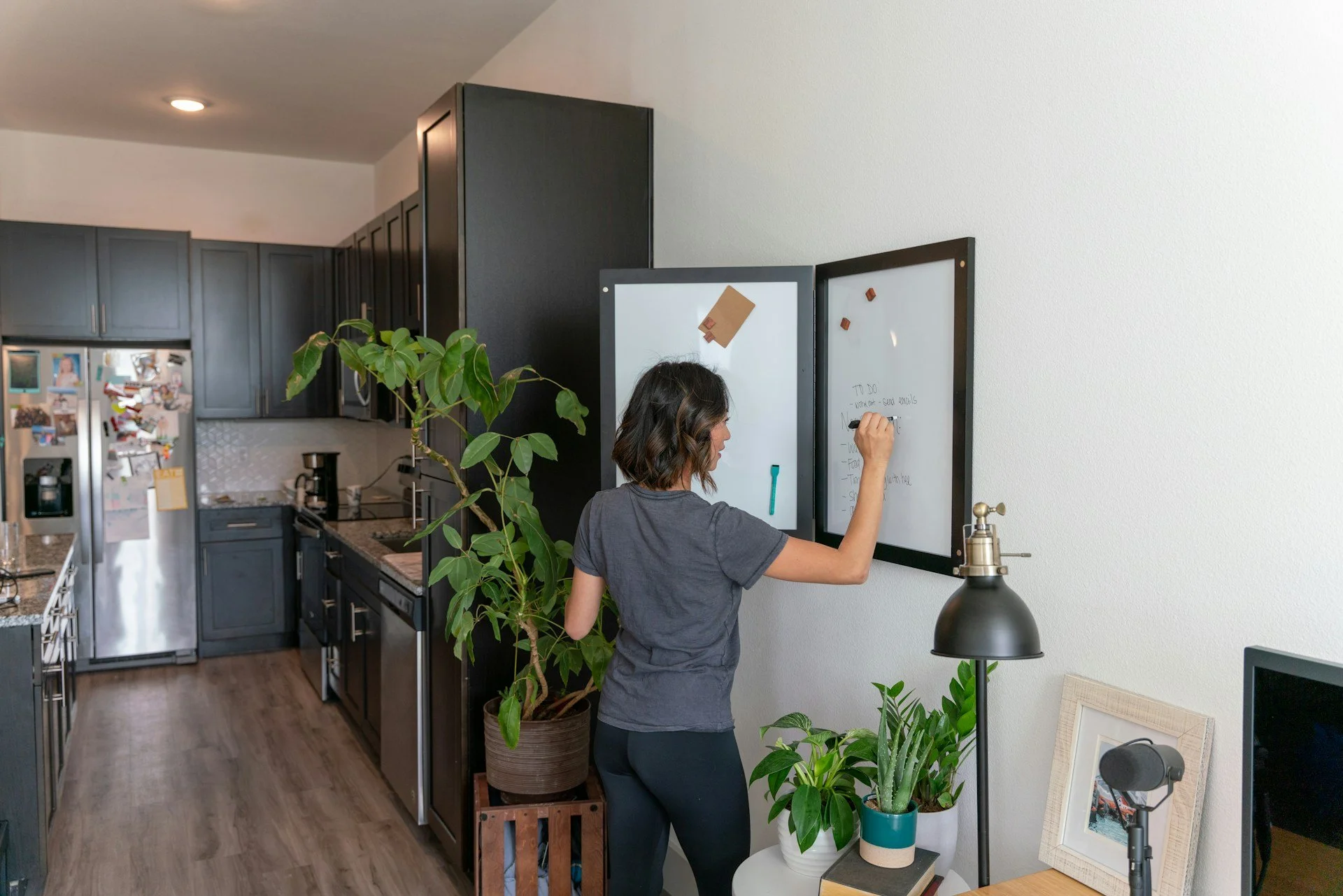
Every session follows the same reliable cadence.
1. You bring a topic. The organizing challenge, pattern, or question you want to focus on that day; something that connects to the bigger picture goal you established in your first session.
2. We look back. Before arriving, you'll complete a Field Notes form. We use this to reflect upon what happened between sessions: what you tried, what you noticed, what got in the way, and what you learned. Then we return to your topic.
3. We get oriented. I help you clarify what you're hoping to get out of today's session, what would tell you that we got there, and how this fits into your Big Picture.
4. We explore, and build knowledge and awareness. Through conversation and exploration, we deepen your understanding of yourself and your topic. I contribute ideas from my organizing experience when relevant; always with your permission.
5. You design a between-session action. In the final third of the session, I’ll support you in designing a specific experiment for you to try before we meet again; planned in enough detail to make it realistic.
Occasionally it makes sense to try something briefly during the session itself; a quick practice or demonstration to give you a felt sense of what we're discussing. But this is the exception, not the rule, and it never tips into a full virtual organizing session. That's not what this is.
Over time this creates something most organizing approaches never do: real self-knowledge about how your brain works and the confidence to use it.
The first session is different. We spend time on your Big Picture: what you hope to achieve and how you hope to be different as a result. This becomes the north star for everything that follows.

Between-Session Experiments: Becoming a Keen Observer
This program is built on a simple but powerful model: awareness, action, and learning, each cycle building on the last.
Awareness happens in the session through conversation and exploration.
Action happens between sessions when you try something new.
Learning happens when we come back together and look at what occurred
This model only works if you are able and willing to engage in some work between sessions. It doesn't have to be perfect, and it doesn't have to be big. But it does have to happen. If you cannot do anything between sessions, this program is not the right fit for you.
The action you design at the end of each session is not a task to complete perfectly. It is an experiment; something to try, observe, and report back on. You are not being graded.
Between sessions, your job is to be a keen observer of yourself. Think of yourself as a field scientist studying a subject you find fascinating. A good scientist doesn't judge the data. They simply observe, record, and let what they find inform what comes next.
Before each session, you will complete a brief reflection form called Your Field Notes. This is where you report what you observed; what happened, what you noticed, what made it possible, and what got in the way. If you didn't attempt the action, that's useful information too. The non-attempt is often more revealing than the attempt. It's all part of the learning.
Your Field Notes become the starting point for our next session. What you observe between sessions is what drives the work forward.

Who this is for
This is a strong fit if you have some awareness that your brain works differently and you're ready to understand it more deeply.
You've likely tried to get organized before. You may have worked with an organizer in the past or be working with one presently, yet a piece of the puzzle is still missing.
You're looking for something different than the hands-on, “done-for-you” approach. You also need insight, strategy, and support that fits how you think.
You don't need to have it all figured out. You just need to be curious about what's actually getting in the way and willing to do something about it between sessions.
This is not a good fit if you're looking for me to organize your home for you, if you're working against a deadline, or if you want a one-time reset. There are excellent professionals who do that work, and I often partner with them, but my contribution is fundamentally different.
One additional consideration
This program works best for people who are ready to make decisions and take action, even incrementally.
If your home contains years or even decades of accumulated items and the idea of making decisions about them feels completely impossible right now, a different kind of support may serve you better first. Many clients benefit from a combined approach with both an in-person organizer or declutterer and a coach like me who can help with stuck patterns.
Regardless of what you need, I can point in you the right direction on the introductory call.


Ready to Get Started?
The first step is a brief 15-minute introductory call. We'll talk about what's going on and determine whether this approach is a good fit.
If it is, we'll choose a weekly time and reserve it for the full eight weeks.
If it's not, I'm happy to point you in a different direction.
If no times are currently available, you can join the waitlist and I'll reach out when a spot opens.